


Closing Costs on Long Island: What Buyers Actually Pay (and Why)

You saved your down payment and you finally got pre-approved.
You did the hardest part, you find a house you love… then your lender hands you an estimate with another very large pile of money due at closing.
Wait, WTF.
Welcome to New York real estate.
The question I hear isn't usually:
“What are closing costs?”
It's: “Ashley, why is this number so freaking high?”

Yeah, Fair question. I asked that when I closed on my house too.
Here's the first thing I want you to understand:
Your closing-cost number is not one giant fee.
It's a pile of completely different expenses and often times, people interchange the terms.
Sometimes they happen to get grouped together because they're all showing up around the same time. It’s made up of actual transaction costs, financing costs, taxes or insurance.
Quick Answer: How Much Are Closing Costs on Long Island?
There is no universal Long Island closing-cost percentage that works for every buyer. Your total can change based on your mortgage amount, lender, property taxes, homeowners insurance, title expenses, whether you're paying points, the timing of your closing and other property-specific adjustments.
You'll often hear buyers use a percentage of the purchase price to create a rough savings target. That's fine, I would go with 5% of your Purchase price.
Once we're looking at a real house with real financing, I want real numbers.
Why Can Two $700,000 Long Island Homes Have Different Closing Costs?
This is the part buyers need to understand. Imagine we're comparing two houses.

So What Are You Actually Paying For?
A Long Island buyer's closing expenses include:
Mortgage-related lender fees (seen on your Closing Disclosures)
Appraisal ($600)
Credit-related charges
Mortgage recording tax ($150)
Title search and title insurance
Attorney fees ($1500-$2200)
Recording charges
Homeowners insurance (Variable paid before closing usually)
Prepaid interest
Property-tax escrows
Insurance escrows
Tax adjustments
Mortgage insurance when applicable
Other property or financing-specific charges
Not every transaction contains every expense or even all of these, And not every line item behaves the same way.
So yes:
There are a lot of people at this table, and apparently several of them brought invoices.
Title Insurance: What Am I Paying For?
Lets start with Title Itself:
Without Title, no one would check if there was leans and judgments against the home, that means if a homeowner took out a loan to get new windows on the home for 30K, and defaulted on it, then sold the home, since the loan was attached to the home, its now your problem. (Yes.. we are over simplifying to make a point here)
Title insurance is another line item buyers see and understandably ask: “What exactly is this?” And I get it, Title Insurance is not really Sexy or Appealing, Until something goes wrong, Like most insurance…
Before you take ownership, the property's title history is examined for issues such as liens, judgments, unpaid taxes or other claims that could affect ownership.
Title insurance is designed to protect against covered title problems that weren't discovered before the sale.
This isn't particularly exciting. Nobody has ever called me and said: “Ashley, you know what makes me happy? The title insurance.” But protecting your ownership interest is one of those boring things I care quite a bit about.
Boring is wonderful when boring prevents expensive problems later.
Why Is So Much Money Going Into Escrow?
This is probably one of the biggest sources of closing-cost confusion.
If your lender establishes an escrow account, money may be collected for future property taxes and homeowners insurance, so you are working in a surplus when it’s time to pay the bill next year.
That money isn't necessarily a “fee.” It's money being collected so those future obligations can be paid. And on Long Island, where property taxes can be substantial, those escrow numbers can make the cash-to-close estimate look dramatically larger.
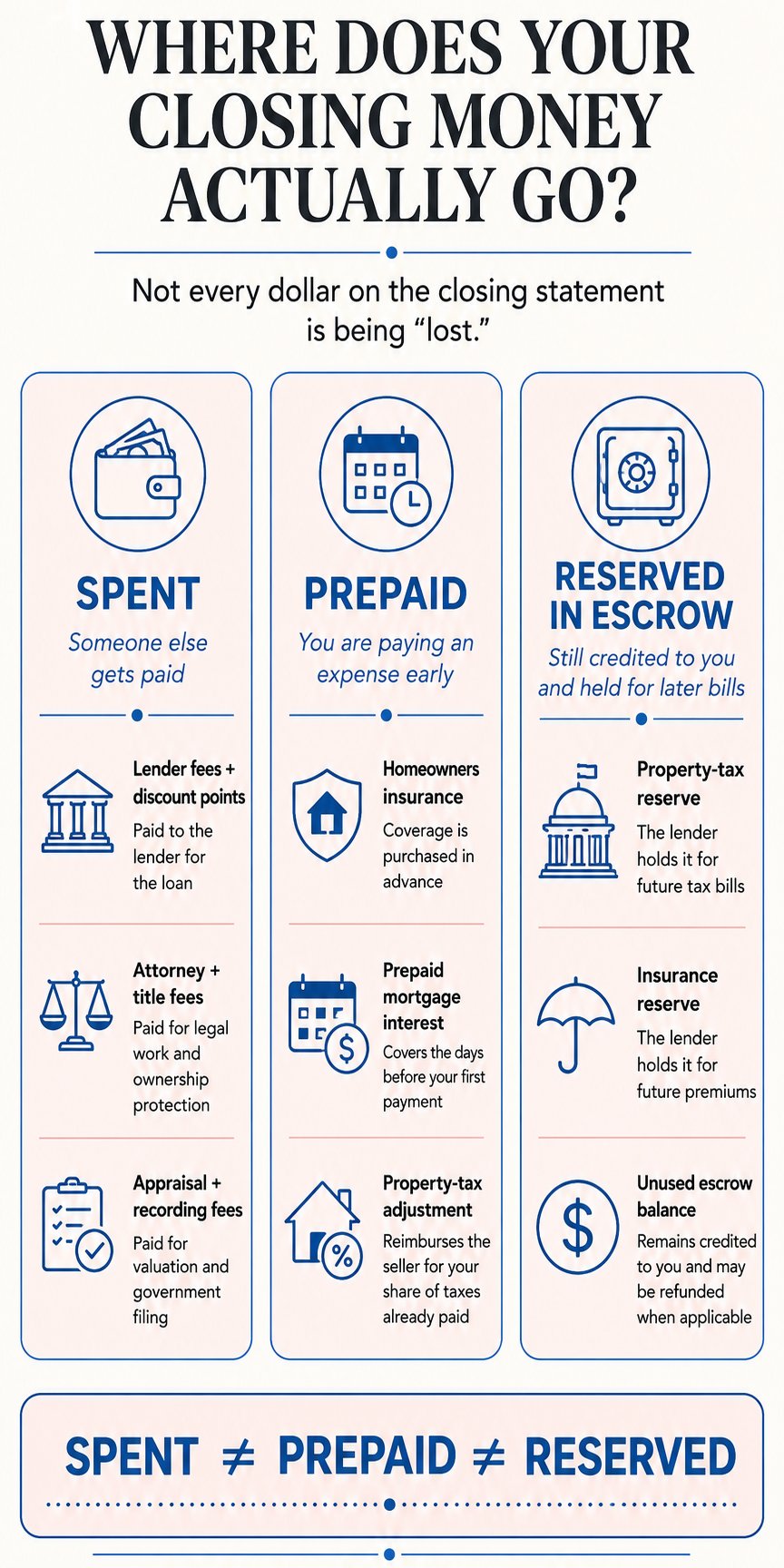
Property Taxes Effect your Closing Costs:
Timing matters too. Property taxes and other items can be adjusted between buyer and seller depending on what has already been paid and the timing of closing.
That's why your estimate can change as we get closer. It doesn't automatically mean someone made a mistake or we were manipulating the numbers, It may simply mean we're replacing estimates with actual numbers. (For example closing at the end of the month is always cheeper than the beginning of the month…)
As we move through the process I hope to work with our team to be as consecrative as possible, then over time, with more and more details added, the picture gets clearer and clearer.
Why Your Loan Estimate Matters
Once you have actual financing, your lender should provide documentation showing estimated loan terms and closing expenses. Don't just scroll to the giant number at the bottom. Read the categories. Your agent should be able to help guide you through what parts are normal fees and where you have room to negotiate.
What Questions should I ask my Lender When I get my closing Estimate:
Which costs are lender fees?
Am I paying points?
Which charges can vary?
Which amounts are taxes or government charges?
How much is going into escrow?
What am I prepaying? (Am I buying down my rate) Why is that my best option?
What could still change before closing?
Do you expect any figures to change before closing significantly?
This Is Another Place Your Agent Should Be Useful
If your lender handles the mortgage and your attorney handles the legal side of the transaction, where does your agent fit?
I'm looking at how the entire transaction fits together. (Could you get a better rate? Are you being offered everything Ive seen before that makes sense within this context?)
If we're negotiating terms that could affect your cash position, I want us thinking about that strategically. If preserving liquidity matters to you, that should influence how we structure the purchase.
And if you're staring at a document full of unfamiliar charges wondering who you should ask, I can help get the right question to the right professional.
I need to make sure you aren't navigating four different professionals while nobody is looking at the whole chessboard. That's the value of good representation.
Closing Costs vs. Cash to Close: They're Not the Same Thing
Closing costs are the various expenses associated with completing and financing the transaction.
Cash to close is the amount you ultimately need to bring after accounting for things such as your down payment, deposits already made, applicable credits, closing expenses and adjustments.
So when someone says:
“I have $100,000 for my down payment.”
My next question is:
Do you have $100,000 total or $100,000 specifically allocated to the down payment? Again, these are commonly combined, but to your lender and myself they are different numbers.
This is exactly why we wrote How Much Money Do You Need to Buy a House on Long Island?
Should You Ask the Seller to Pay Closing Costs?
Depending on your financing and the deal, a seller concession may be available toward allowable buyer expenses.
We need to understand the market, the property, competing offers and what matters most to you. Sometimes preserving cash is worth prioritizing OR purchase price matters more.
ALSO, depending on the loan you get, you can only get SO MUCH assistance with closing cost coverage, so this is exactly where a good agent can navigate what actually benefits you.
For example, should we negotiate 15K off the purchase price of this 700K home, or should we offer 700K, and ask for 15K to buy down your interest rate?

Together we need to decide which concessions actually improves your position in buying.
How I Want You to Budget for Closing Costs
Before you're seriously shopping, get a conservative estimate from your lender.
We need a baseline, even if it’s not perfect.
Then, once we identify a property, update the estimate using:
the actual purchase price
the actual taxes
the actual loan structure
the actual insurance estimate
and eventually, the actual title and transaction information.
Your closing-cost estimate should get more accurate as the transaction gets more specific.
Ok you got this far in the article and you are still working on everything all on your own, or (let's be honest) with a team thats leaving you to google other agents BLOG POSTS.... Lets cut to the chase... I'd love to help you, and our conversation is always no pressure, confidential and lowkey.


Comments